Graphic Novel Math
Friends who know me know that I go on and on about toxic graphic novel schedules in the traditional publishing industry.
And this is a hard problem to prevent without publisher support. It’s ultimately the publisher who sets the production schedule. If a publisher wants to buy a graphic novel pitch from you and tells you that they want the release date to be two years from now, no ifs ands or buts, well, there’s not much you can say.
And you should turn down that deal, by the way.
To avoid a toxic schedule, a graphic novelist first needs a collaborative publisher that understands the graphic novel is a labor-intensive undertaking. Four to six jobs are often performed by one person. That sort of workload takes a long time, is physically taxing, and it can be hard to foresee unexpected pitfalls, obstacles, and emergencies that may slow down progress.
I have a few thoughts on how to make graphic novel production more sustainable for both graphic novelists and publishers, and in this post I’m going to focus on one thing that graphic novelists can control: an understanding of your own workflow. Before signing a contract, it’s imperative for a graphic novelist to understand how much time it takes them to draw a comic.
It’s time for some…
Graphic Novel Math
Supplies you’ll need:
- the comic you’re going to work on
- a stopwatch, clock, or time tracking app
- a spreadsheet, journal, notes app, or time tracking app
- a calculator

Step 1: Draw Comics
Ideally, you will do this before pitching a graphic novel. Before you sign a contract with a publisher agreeing to a massive project, you should have a good understanding of how likely you are to complete a massive project. You can only do this by practicing.
So, draw comics. Draw webcomics. Draw short comics. Draw ash cans. Join anthologies. Self-publish comics. Do comic projects where the stakes are lower and you can work at your own pace. Develop a style and a workflow. Develop your own best practices. Understand how you like to make comics.
Step 2. Track Your Progress
Got some personal comics to work on? Okay, now let’s get to tracking.
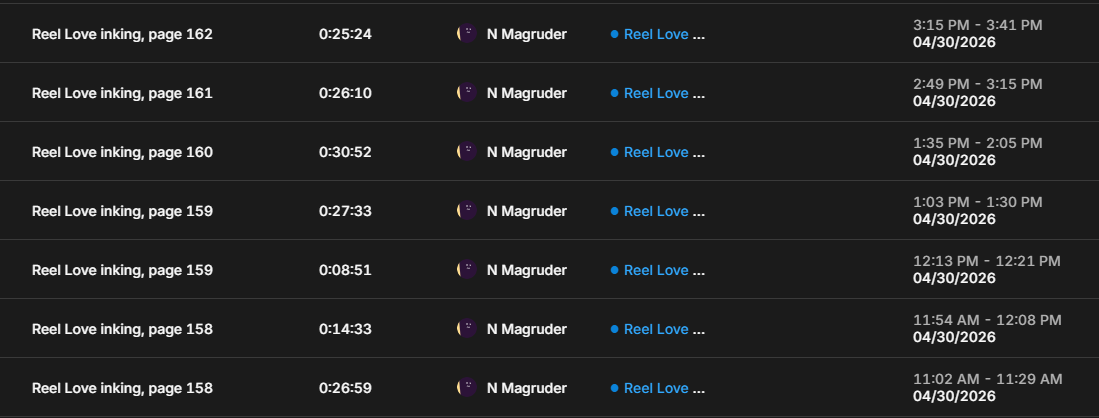
Whenever you’re working on your comic, no matter what stage in the process, time it. I use Toggl Track to track my work hours, but you can use a stopwatch, or a timer, or even just a clock. Start the timer or record the time at the beginning of the task. When you stop, stop the timer or record the time. Also record the number of hours and minutes spent working uninterrupted. If you take a break, stop the count, and then start it again when you return.
Your goal here is not to set a target and then meet it. Just keep track of how much time you spend on a task as you’re working at a comfortable pace.
Time how long it takes you to thumbnail a comic page. Time how long it takes to pencil a comic page. Time how long it takes to letter a comic page. Time how long it takes to ink a comic page. Time how long it takes to color a comic page. Time how long it takes to illustrate a book cover. Time how long it takes you to write your comic scripts, if you do so.
Do this for every single page of your comic. Do this for all the different comics you make. You want as much data as possible.
Your comic process may involve more steps than this, or only a few of these steps. There is no right or wrong number of stages in the comic-making process. This is your time to decide what is important to your workflow and how much time it takes.
Step 3. Record Your Progress
Now, here’s the most important part.
Take time you’ve tracked and write it down.
Keep a record of how much time you spend on your comics. One reason I like Toggl Track is that you can set up projects, name each individual session, and Toggl keeps track of all this information for you. If you’re not using a time management app, you’ll have to do this step another way. Spreadsheets are good. So are journals. Save this information somewhere safe.
Now that you have comic-making experience and you’ve tracked how much time your comics process takes, you have the information you need to develop a graphic novel schedule.
Daily Production Rate
First, we’re going to take the data you gathered about your comic workflow and figure out your daily production rate. Look at the time spent on each stage of the comic and decide on a best estimate of hours needed for a single page. You can use an average for this number, for example add up all the times spent on 30 pages of comics and divide by 30.
You can also make an educated guess. Say across 30 pages of comics you spent from 8 to 10 hours on inking for most of them, but there are one or two pages that took closer to 20 hours. We can treat those 20-hour pages as outliers. That leaves us with 8, 9, and 10. We can err on the side of caution and say the average page will take 10 hours to ink. You’re not being graded on this so the math doesn’t need to be completely accurate. Math won’t fully account for the reality of your day-to-day life as you’re working on a comic. We just want to have a realistic number based on actual results.
Do this across every stage of the comic. You should have a number of hours for every specific task. Now, divide 8 by that number. The 8 represents 8 hours in a single workday. Now you know how many pages you can get through in a single workday at each stage.
8 / number of hours per task = daily production rate
ex. 1 hour to thumbnail 1 page = 8 pages per day
2 hours to pencil 1 page = 4 pages per day
3 hours to color 1 page = 2.67 pages per day
You might be thinking, well I typically work 10 or 12 hours in a day. We’re not going to do that. That is a recipe for burnout. And what if you get sick, or there’s an emergency? If you’re creating a schedule that has you working more than 8 hours a day, you’re creating a schedule at maximum output. It doesn’t account for days when you might crash and not be able to get much done. It gives your publisher unrealistic expectations and you risk disappointing them if you can’t meet the pace.
You’ve collected the data. You know how long the work takes you. Our goal now is to build a healthy, sustainable schedule.
How Long Will Your Graphic Novel Take?
This next equation determines how much time you’ll need to complete your graphic novel. It works best if you know how many pages your GN is. This might be hard to figure out if you haven’t written a script. Scripts are not always part of a comic creator’s process. If you don’t have a script and haven’t yet figured out how many pages your GN will be, use your best guess.
total number of pages / (daily production rate * 5) = number of weeks needed to complete work
The “5” represents the number of work days in a week. I could make it 7 days, but that is not a healthy work schedule, and our goal here is to avoid a toxic situation. To work, you need to rest, so let’s stick with 5 workdays.
Let’s assume this graphic novel is 200 pages. The artist can do 4 thumbnails in an 8-hour work day (daily production rate). Multiply that by 5. The artist can thumbnail 20 pages in a 5-day work week. That’s their weekly production rate.
Divide that number into 200.
200 / 20 = the artist needs 10 weeks (roughly 2 1/2 months) to complete thumbnails.
You’ll need to do this for every step of the process.
thumbnail + penciling + lettering + inking + coloring + cover = total art production time
This conversation should happen before you sign a contract. If you agree to a publisher’s terms before telling them yours, it’s too late. The publisher is not obligated to give you anything that is not in the contract.
Now Here’s the Hard Part…
If a publisher tells you that they can’t give you the time you need? Turn down that contract.
Most publisher contracts include the development and release schedule for the book. They also include a clause about what happens if the author is unable to finish the book on time. The most common consequence is that the publisher cancels the book and all the advance money they’ve paid the author is due back to the publisher. If you’ve determined the amount of time you need to complete a graphic novel and you accept a publishing deal for less than that amount of time, you’re responsible for the consequences if you’re not able to meet the terms of the contract.
Do not sign a contract unless you are sure you can meet the outlined terms.
What Can Publishers Do to Help Graphic Novelists?
The honest truth is that graphic novels take a very long time to produce. Longer than picture books. Longer than prose novels. And the only people on a graphic novel team equipped to know how long drawing a graphic novel takes are the artists drawing it.
There are some things publishers can consider that will take a bit of pressure off the entire team.
Don’t Put the Book on the Release Schedule Until Art is (Near) Complete
Publishers keep an internal schedule of when books will release, organized by season. It’s standard for publishers to determine the release schedule at the time of the deal and to write it into the contract. This starts the clock on finishing the graphic novel. It’s easier to commit to a release schedule with a picture book or novel, which usually takes one or two years to complete.
It’s much harder when working with graphic novels, which often take three or more years to complete. I think it’s a better course of action to keep a graphic novel off the release schedule until the art is complete, or close to completion. When the art is done or near done, there is no longer any guesswork about when the art will be done. The publisher can be confident that they can place the book on the release schedule without worrying they might have to take it off because the artists can’t meet their deadlines, after all (which has happened to my publishers!).
This might be a scary move for publishers who are not confident that their artists will complete the book in a timely manner. You don’t want the project to drag. Unfortunately, graphic novels are not the books to publish if you don’t want a project that drags. Graphic novels take years to complete. They drag, a lot! As graphic novel publishers, you simply have to get used to that. Comics are a marathon, and holding artists to unrealistic schedules will not give you better results. More often than not they overwhelm the artists to the point that they’re unable to work. Instead, publishers should be understanding and supportive. Artists work most efficiently when they know their team has their backs.
Don’t Announce the Deal Until Art is (Near) Complete
Announcing a book deal in Publishers Marketplace or Publishers Weekly is an exciting, momentous occasion. However, it doesn’t need to happen as soon as the deal is agreed upon. Publishers can wait to make the announcement. Much like I discussed with release schedules, announcing the release date too soon puts pressure on the graphic novel team. It’s a better move to hold the release date until the book is complete or nearing completion. The book is announced closer to the release date and readers have less time to wait, so they will not forget about the book between the announcement and release.
Make Time for Notes and Editing in the Schedule
If the publisher must commit to a development schedule right away, then for the love of all that is holy, include time for edits! This is something none of my previous publishers have done. A schedule that makes no time for notes guarantees a book that is not getting finished on time.
Just like graphic novels takes longer to develop than picture books and prose novels, editing a graphic novel takes longer, too. Editors, it is in your best interest to budget time in the schedule for editing.
And keep in mind, if you are unable to give edits on time, the artists will not be able to complete their work on time.
Hire More Artists
Notice how I keep saying “artists” and not “artist”? That’s because making comics is a team sport.
In a traditional comic book production pipeline, each step of the comic process is one specific job. Marvel and DC will sometimes hire two artists just for one role. Producing a comic can easily require up to six artists. The way we make graphic novels these days requires a single artist to do the work of six.
If you’re not going to give them help, then you must give them time. And money.
Listen: drawing is intense work, and drawing on crunch time can cause mental and physical damage that is hard to recover from. A publisher may give half the time that the equation calculates, and perhaps an artist can do the work in that time, but not every artist can work at that pace, and the artist who does may not know the damage they’re doing to their body right away.
Above all, remember this: publishers don’t provide health insurance to authors.
In Conclusion
Artists, your best defense is to be armed with information. Do the math and determine how much time you need to complete the work.
Editors, take the time to learn about the comics medium and understand the labor that goes into making comics. Then plan accordingly.
Don’t approach comic schedules in terms of what’s possible. Approach them in terms of what’s healthy.